.png)
Conservation or Convenience: The AI Question Arrives in Watauga

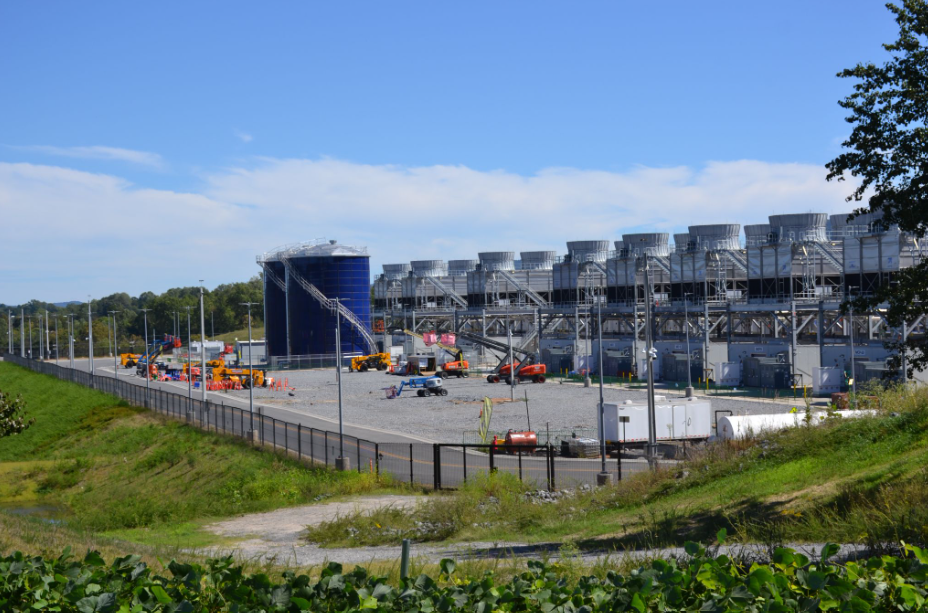
Google Data Center 4’s facility under construction in Lenoir, NC. The data center has a planned operating capacity of 91 megawatts. Photo Credits: Andrew Larsen.
Andrew Larsen, Podcast Desk Lead for The Powderhorn
The AI question has arrived at Watauga High School: ‘to use or not to use?’ It’s a hot topic in the news at the moment, and most anyone you talk to will have an opinion. Employees of major Artificial Intelligence corporations recently expressed their concern over the speed at which it is advancing and one even warned that it may kill us within ten years. On the other side are fears that China out-paces the United States in advancement, diminishing the country’s position as a global superpower. Local worries revolve around the construction of AI data centers within communities, contributing to higher utility (electricity, water) bills and the damaging or destruction of ecosystems. At the same time, people are increasing their AI usage via generated content and online chatbots.
Cutting back to Watauga County, these fears are amplified in the wake of Hurricane Helene. Even prior to the disaster, Boone pursued climate goals such as a 54% reduction in emissions by 2030, and community-wide carbon neutrality by 2050. Watauga High School itself was previously LEED certified in 2012, a certification system designating a building as ‘green.’ However, it is uncertain whether our building continues to meet these requirements. The issue of Watauga High School’s environmentalism is further complicated by Artificial Intelligence.
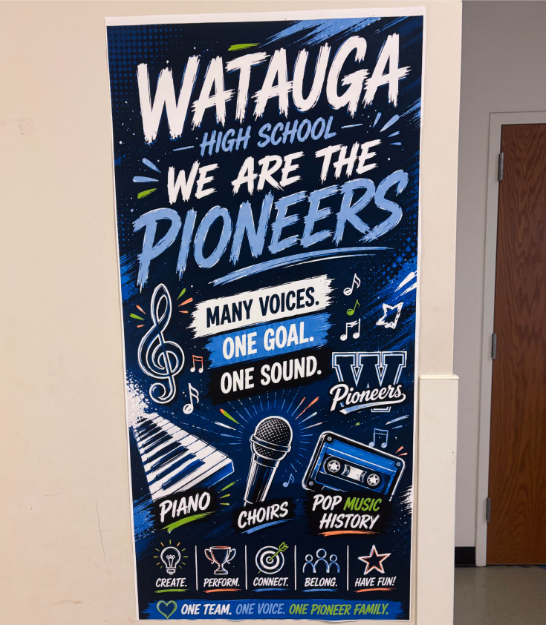
An AI-generated poster out front of Mr. Lancaster’s choir room advertising the various music classes he teaches. Photo Credits: Andrew Larsen
Jennifer Wilson, Watauga’s newest assistant principal, mentioned that she typically uses generative AI as a thesaurus, with little to no use beyond that. Wilson offered a window into the greater administrative team’s use of AI.
“I know Ms. [Leslie] Pope has worked really hard on designing things herself using Canva, which does reach into the AI space a little bit,” said Wilson. “A lot of what we’re designing are things that we are laying out first, walking through, and designing individually. Whether or not we’re using graphics that were created with AI, they’re all specifically being placed to catch the eye and to draw students in, to read what administration and staff have taken time to put together. The message is not AI, it’s what’s coming from administration.”

A recent addition to Watauga High School’s posters. A source of controversy are the AI graphics featured throughout the design. Photo Credits: Andrew Larsen.
The administrators have no rules governing their use of AI. Students, of course, are expected not to use AI to complete their schoolwork for them but may use it to help their work process. Yet, the line is unclear on where assistance falls into cheating. AI is a relatively recent development, making this distinction difficult to define. Its rapid advances leave policy struggling to keep up, similarly to when the internet was invented. Wilson believes that student education on the “appropriate uses of AI” is of importance at this moment.
“The manner in which we are using AI,” said Wilson, “is a manner in which I would teach a student. For me specifically, with my writing, if I don’t like how it sounds, plugging what I’ve already written into AI for professional purposes, and then pulling pieces that I like from it. I would absolutely teach a student how to effectively do that.”
This is more difficult than it sounds, however. Students may be extensively taught on the proper applications of AI, yet continue to cheat with it. This burden falls on our teachers, and they combat it in different ways, whether it be cutting technology out of the equation or trusting their personal detection skills. Yet, it does have practical applications as Samuel Vining, a Civics and AP US Government and Politics teacher at Watauga, explains.
“One really useful tool that I’ve seen in the classroom is using it as a reference for bills and sourcing,” said Vining. “If you want to find out legislation, you can just throw it into artificial intelligence and they’ll give you the legislation back really quickly. A while back, you had to really painstakingly go through and find legislation, and so it helps with that. In terms of how I teach it with students, the most important thing that students need to remember when they’re using artificial intelligence is it does have an ecological cost.”
Vining highlights what is perhaps the driver of controversy over AI. In 2023 alone, AI data centers used an estimated 228 billion gallons of fresh water, most of which goes towards generating electricity. Yet, it doesn’t need to use these amounts. Renewable technologies such as closed loop cooling systems are estimated to reduce water consumption by up to 70%, but data centers typically do not utilize this due to increased cost. In North Carolina, there are 15 data centers operating with a capacity of 502 megawatts. There are 60 planned data centers which would increase the total operating capacity to 4,529 megawatts, enough energy to power roughly 3,170,300 homes.
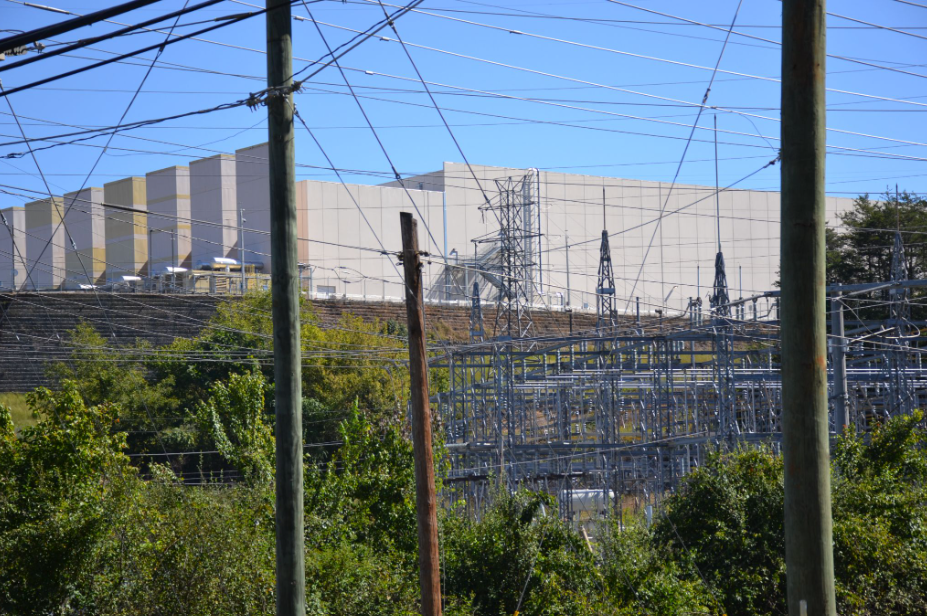
Google’s data center complex in Lenoir, NC. Data centers one, two, and three operate at 259 megawatts. Google announced plans to invest another $1 billion in the facilities in March, 2026. Photo Credits: Andrew Larsen.
It’s easy to forget the presence of these facilities when Watauga County does not currently have any data centers. Yet, just down the road in Lenoir, Google has built three data centers with a fourth under construction. Watauga County has placed a moratorium on data center construction, meaning none may be constructed until at least April of 2027, to give the County Commission and State Legislature time to impose regulations upon construction projects.
As previously mentioned, the broader community of Watauga County as well as Watauga High School have ostensibly supported environmental measures following Hurricane Helene. Meanwhile, Watauga County has the highest proportion of AI users out of all counties in North Carolina with 47.2% of working age residents using it in some form. Wilson said the following when asked about how the high school plans to balance AI use with the environmental message of our school and community.
“I don’t think it should be the absolute end all be all tool,” said Wilson. “I recognize the environmental concern with it. I understand the local community and want to continue to support the local community’s initiative when it comes to those climate concerns, especially given the recent events with Helene. Even though I did not live here during that time, I have read up and understand the research behind why that tragedy occurred. I do want to continue to support the local communities initiative in combating climate change, and a lot of that does come from those data centers.”
Now, our community must grapple with the age-old question of environmental protection or convenience. Convenience, too, comes with a price beyond ecological damage.
“I think if you use AI a lot, you can lose your authenticity,” said Vining. “So you have to balance it. You’ve got to make decisions about how you want to use it.”


Comments