.png)
The Scheduling Struggles of A/B Classes
- Brayden Howard

- Mar 12
- 5 min read
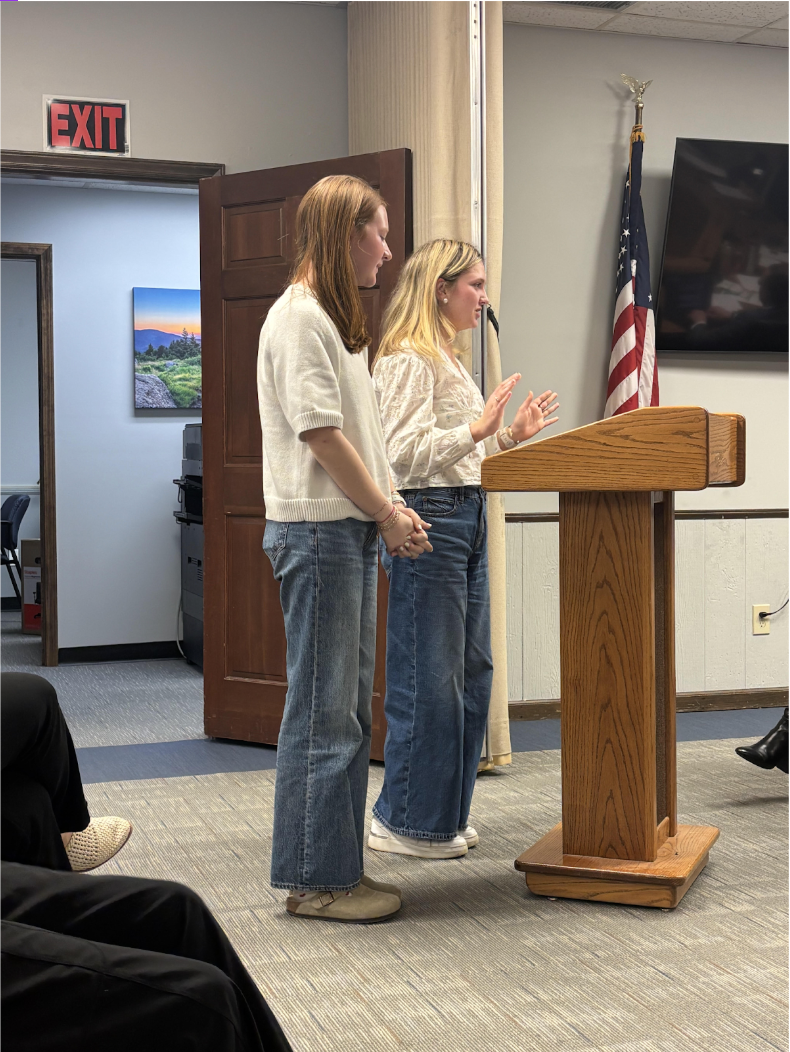
Rebecca Billette and Ariail Lewis discuss issues facing Caldwell enrolled students at a school board meeting. Later in the same meeting A/B schedules were discussed before the board. Photo Cred: Carrie Bradbury, Desk Lead for The Powderhorn
Brayden Howard, Staff Writer for The Powderhorn
Watauga High School uses a unique scheduling system where certain classes are available as “blocks” that are every day for one semester, and other classes are “A/B”, every other day for the full year. While this scheme allows students to take classes in a structure better suited for individual courses, it also creates repeated issues and headaches for students and administrators alike. This year the A/B pairings have moved from second and third block to first and second.
For several teachers and students this change seemed unnecessary or potentially even problematic. The A/B pairings were also one of the things that caused a multitude of problems for students.
“I’m in concert band, so I was planning on that class, but I also wanted to take AP Pre-Calculus, AP World History, and AP Statistics, and those four classes are all 1st block year-long classes,” said rising sophomore Max Greene. “You can only really take two of these AP classes at a time because they’re all first block A/B.”
First block A/B has a total of 7 AP classes in it simultaneously, most of which are not available as block classes. This conflict means most students are limited in the number of APs they’re capable of taking in one year. The administration views this as a necessary complication for simplifying the schedules overall and to provide an easier process for those not taking Advanced Placement classes.
“We have a lot more students coming to us behind grade level. So one thing I noticed two years ago was our standard Math 1 classes---whether it’s just a semester or it’s year long---there were multiple classes with 30 students in them, and all of our honors classes had 20,” said Watauga High School Principal Dr. Scott Strickler. “So students that came to the high school either at grade level or behind grade level were in these exceptionally large classes. Over time that trend has continued upward, especially the last 10 years. If we have an AP class of 30 and a standard level class of 25, that, to me, seems more equitable than an AP class of 15 to 20 and a standard level class of 30.”
The decision to make A/B classes primarily the home of advanced and AP classes does have some concerning impacts on A/B elective classes including Strings/Orchestra. The 2nd block of A/B classes, for example, only has three entry level classes, being Strings/Orchestra, 3D Modeling & Animation, and Choir.
“There’s six AP classes that you can take in the second block, and then there’s economics, 3D modeling, or Orchestra. That’s about it. So my choices are an AP class, orchestra again, or economics,” said rising junior Brayden Ward. “The problem is there’s too many AP classes shoved into that block, there’s not enough non-AP classes you can take. We just need more classes, and they need to change them from being all AP.”
Several classes previously offered were also removed this year, including standard Horticulture and Construction Core, and while some of these decisions are made at the state level, many are choices made by Watauga High School’s Curriculum Committee, a group who meets in November each year to determine the class selection for the next year. However, the curriculum committee did not have oversight over the decision to change A/B pairings.
“There’s representatives from the Central Office. We have Dr. Childers, he’s the chair of the School Board. April Reyes, she’s our registrar who does a ton of scheduling. There’s at least one or two reps from student services, one or two counselors, teachers from every department and school, school administration, and I think there’s always been at least one [Assistant Principal] and the Principal has been on it,” said Strickler. “So they decide what new courses go on the course catalog, while also hearing if we can remove a course.”
Keana Triplett, curriculum specialist, is a member of the Curriculum Committee. Their last meeting was in November.
“While Curriculum committee did not provide specific feedback regarding the pairings, I do know that a few members were asked to provide some feedback on the pairings before they went out”, said Triplett.
Ultimately though, administration has final say in most decisions, especially those so critical to the student experience as scheduling choices. Strickler intended to consult with the Student Council prior to releasing the schedule, but a meeting was not held until after the schedule’s release. In the end, the largest changes to the schedule were largely administrative initiatives. Attendance in 1st period college classes had been found to be around 10% lower than in classes later in the day. While this effect is lessened in high schools, it is still present. This data about higher education was a driving factor behind administration’s hopes to level the playing field for students.
“Yes, that was admin. Because, you know, in the morning, there's all kinds of studies saying students perform worse in the morning. The goal is to set up kids for something successful after this. It could be a job, it could be college, it could be enlisting in the military, but hopefully one of those three paths,” said Strickler. “Most of our students that take AP classes are pretty self-driven or have some motivation from people in their life, whether it be parents, peer groups, any of that. So the hope is, even though those harder classes are first period, if a student is signing up for an AP class, they probably are pretty driven to come to school. The hope is that when students that may not be as excited about math, hopefully this leaves some space for it to be in third or fourth period, and let those students that may be a little bit behind wake up a little.”
A/B classes being primarily AP also provides trouble for students interested in taking those A/B electives and advanced classes, forcing some students to choose between advancing their academics or participating in elective classes.
“These A/B pairings are to the detriment of students who want to take many advanced classes. I was planning on taking three AP classes next year that are all A/B pairings, and I just can’t do,” said Greene. “Concert band is my way of getting practice for my instrument consistently, and it’s making me choose between getting practice for my instrument or taking the classes that best fit me, and I think that’s just a shame. I don’t think anybody should be forced to make that decision.”


Comments